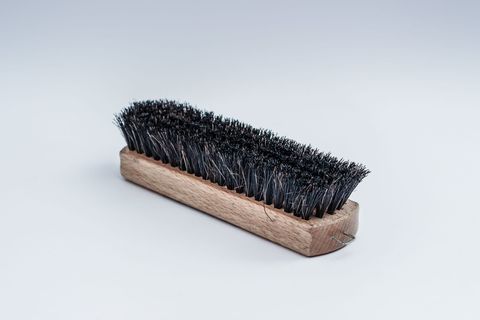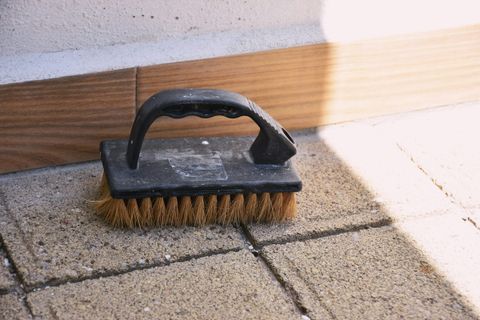
Aslan sources deck, hull, bilge and detail brushes for marine wholesalers, chandleries and boat-care brands from a brush manufacturer in Suzhou that we work with directly, made to your specification under your own brand. You pay us 4 to 8 percent of order value; the factory invoices the goods to you as importer of record. Brushes can share a container with the rest of our marine cleaning range.
The specification that defines a deck brush
Copy this into your request for quotation (RFQ, the document a factory prices from).
| Parameter | What it means | What to state |
|---|---|---|
| Filament material | The fibre in each tuft | Polystyrene (PS), used for deck scrub brushes; polypropylene (PP), which absorbs no moisture and resists most oils and acids; palmyra, a natural palm fibre (Gordon Brush); nylon 6.12 (PA612, polyamide 612), which absorbs 3.0 percent water when saturated against 9.5 for nylon 6 (DuPont) |
| Stiffness grade | How hard the brush scrubs | Extra soft to extra stiff, or a soft ring around a stiffer centre |
| Filament diameter | Thickness of one filament | In mm per grade. A push broom uses about 0.025 inch, or 0.6 mm (Precision Brush) |
| Filament tip | Cut square or split at the end | Split or “flagged” tips hold soapy water (Boating) |
| Trim length | How far the filament stands out from the block | A short trim scrubs stiffer; a long trim flexes into textured surfaces (Felton) |
| Fill density | Tufts per unit of face area | Higher density wears longer; lower density flexes more (Felton) |
| Block | The head the tufts are set in | Wood, plastic or composite (Carolina Brush); length, width, flat or curved body |
| Staple wire | The wire that anchors each tuft | Type 302 stainless steel is used for wet, no-rust work (Gordon Brush) |
| Pole fitting | How the head joins the pole | Thread, swivel or quick-connect |
| Tuft retention | Force needed to pull one tuft out | The toothbrush standard ISO 20126, from the International Organization for Standardization, pulls a tuft at 20 mm/min and requires at least 15 N (Mecmesin); agree a similar test |
| Marking | Head and pack | Your brand, barcode, type or batch number |
Matching the grade to the surface
A Boating magazine buyer’s guide sets out a typical range. Medium-soft polystyrene with feathery tips is safe on gelcoat, clear coat and paint. Medium-stiff polystyrene is for textured non-skid fibreglass decks. Extra-stiff polypropylene is for acid-washing teak and scrubbing below the waterline. An extra-soft nylon head is kept for vinyl and acrylic windows.
What you can change, and what moves the price
Block shape, filament, colour per grade, trim, fitting, logo and packaging are yours to set. Tooling comes first: a new plastic block shape needs a mould, a one-time cost, while a block the factory already makes carries none. Filament follows: brushes are filled by volume, so the filament’s specific gravity changes how much material each head takes (DuPont); polypropylene is low-cost, and polystyrene sells at about the price of natural bristle (Gordon Brush). Quantity spreads mould and setup costs, so volume and repeat orders lower the unit price.
Customs code and duty
Brushes fall under heading 9603 of the HS code (Harmonized System, the world customs numbering); the EU extends it to the eight-digit CN (Combined Nomenclature) code. Hand-held deck brushes sit under 9603 90. Subheading 9603 90 91 covers “household type brooms and brushes” among others, and 9603 90 99 covers other brushes. In TARIC, the EU’s online integrated tariff database, for 12 November 2026, both carried a third-country duty of 3.70 percent (TARIC 9603 90 91, TARIC 9603 90 99). Confirm the code with your customs broker.
EU rules
CE marking applies only to products covered by harmonised EU rules that require it, and must not be used otherwise (Your Europe); a brush with no electrical parts falls outside them. Deck brushes sold to boat owners come under the General Product Safety Regulation (EU) 2023/988: the manufacturer keeps a risk analysis and technical file, each product carries a type or batch number, and an operator established in the EU must be responsible for it (Articles 9, 11 and 16).
What we check before and during production
Before any deposit, we confirm the business licence and export history and see the line that will tuft your heads. Samples are checked against your RFQ. We visit during production, and a pre-shipment inspection with photos and measurements comes before the container is sealed.
Questions buyers ask
Can you match a deck brush we already sell? Yes. Send a photo, price and yearly volume. Our benchmark report costs EUR 199 per product, charged only if we find it cheaper.
When would brushes reach us? With an existing specification, samples take two to three weeks and production typically four to six weeks, plus sea freight. Spring stock in the marine trade is ordered between October and January.
Will the heads fit our current poles? Send a pole or thread drawing with the RFQ; fit is checked on the samples.
Can you supply a known marine brand’s brush? No. We source white-label and ODM (original design manufacturer: the factory’s design under your brand) goods only; see the private label guide.
Is there a minimum order? We work with buyers who fill at least part of a container and reorder. See our deck brush sourcing guide, the agent fees guide and our pricing page.
Sources
- Boating magazine: What to look for in boat brushes
- Gordon Brush: Bristle brush material descriptions (reprint)
- DuPont: Tynex A abrasive filament technical guide (2015)
- Felton Brushes: Brush trim, face and fill
- Precision Brush: Understanding filament thickness
- Carolina Brush: Custom staple-set brushes
- Mecmesin: Toothbrush tester for bristle stiffness and pull-out resistance
- EU TARIC: measures for 9603 90 91, reference date 12 November 2026
- EU TARIC: measures for 9603 90 99, reference date 12 November 2026
- Your Europe: CE marking
- Regulation (EU) 2023/988 on general product safety (EUR-Lex)