To source own-brand deck brushes from China, send the factory a written specification of block, filament, tufting, connector and marine resistance, approve a physical sample against it, and inspect the goods before they leave. In the European Union (EU) a deck brush falls under customs code 9603 90 91 or 9603 90 99, both charged 3.7% duty on imports from China when we checked on 12 November 2026, plus import value added tax (VAT); it must not carry CE marking, the EU conformity mark, and the General Product Safety Regulation applies to it.
This page is general information for buyers. It is not legal advice.
How to specify a deck brush for a request for quotation
A request for quotation (RFQ) is the written brief factories price against. Copy this table into yours, fill in the middle column and attach photos of the brush you sell today.
| Item | What to state | Why it matters |
|---|---|---|
| Block | Polypropylene (PP), other plastic or wood; size in mm; bumper strip | Weight, buoyancy, protection for gelcoat |
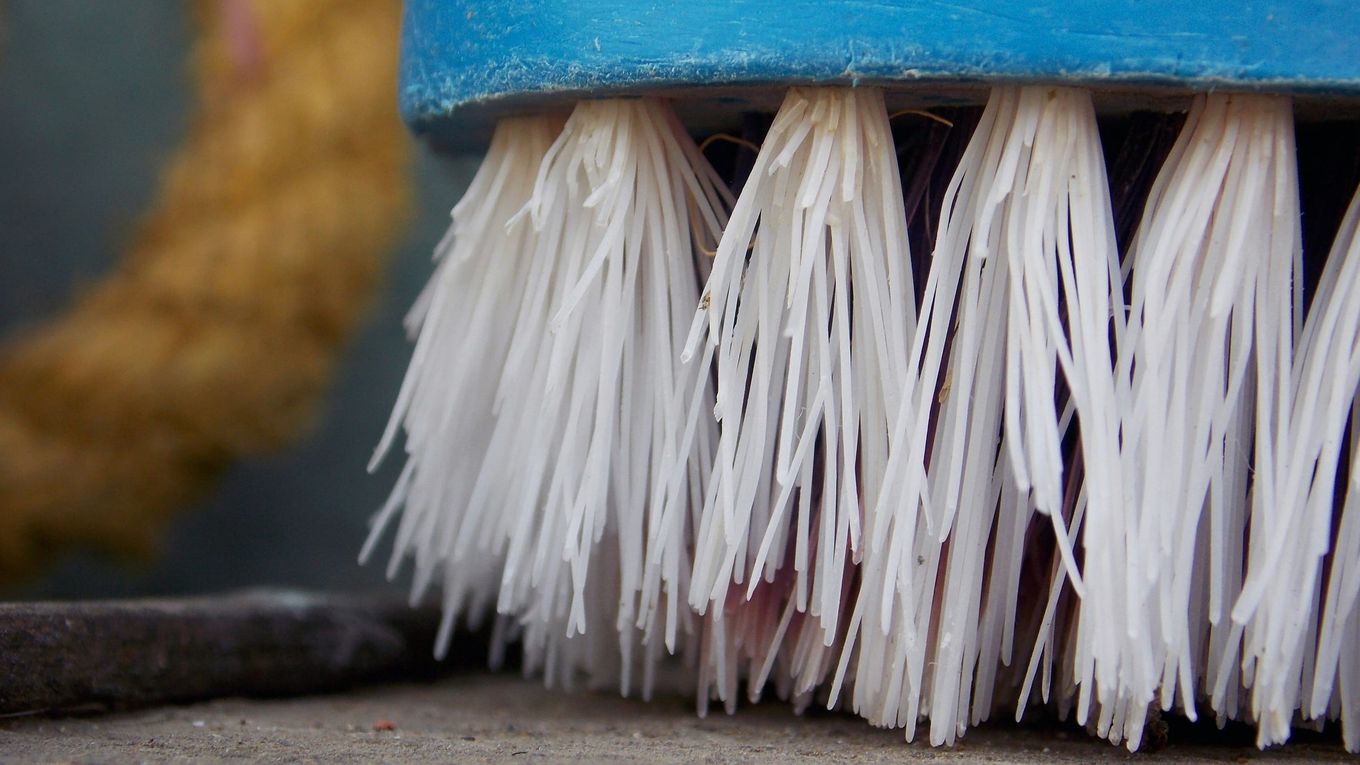
| Filament material | PBT (polybutylene terephthalate), PET (polyethylene terephthalate), PP, natural fibre such as tampico, or a mix | Stiffness, shape recovery, price |
| Filament diameter and trim length | Both in mm | These set stiffness more than the material name |
| Tips | Flagged (ends split into fine fibres) or unflagged | Flagged is gentler on gloss; unflagged scrubs non-slip deck |
| Stiffness grade | Soft, medium or stiff, matched to a reference brush you send | Grade names differ between factories |
| Tuft pattern | Rows, holes, hole diameter | Scrubbing power and filament cost |
| Tuft anchors | Stainless steel grade if metal | Plain steel rusts in salt water and stains the deck |
| Flow-through head | Yes or no; hose connector type | Connector leaks are a common complaint |
| Connector | Thread or quick-connect system; send one of your poles | The head must fit the poles you sell |
| UV resistance | UV (ultraviolet) stabiliser in block and filament | Unstabilised plastic goes brittle in sun |
| Branding and packaging | Logo method, barcode, retail card or bulk carton | Printed packaging often has its own minimum |
Stiffness and the connector cause most disputes. Send your current brush as the stiffness reference, keep an identical one in your office, and ask for the sample head returned fitted to your pole.
Where in China brushes are made
- Yuantan town, Qianshan county, Anhui province. A People’s Daily report republished by China Daily in February 2026 calls it China’s “brush hub”: over 30,000 of its more than 90,000 permanent residents work in brushes, from household cleaning brushes to industrial rollers, and output passed 10 billion yuan in 2022.
- Hangji township, Yangzhou, Jiangsu province. Xinhua, on gov.cn, counts over 2,000 toothbrush manufacturing and supporting enterprises there. It is a toothbrush cluster, relevant to deck brushes mainly for its tufting know-how.
A cluster tells you where to look. Which plant really runs your product is a separate check: we verify the business licence, export history and the production line before any deposit, as set out on our marine cleaning page. The tufting line in our site’s video belongs to a partner factory in Suzhou.
Customs classification and the EU duty rate
The HS code (Harmonized System code) is the six-digit product code used by customs worldwide. The EU extends it to eight digits in the Combined Nomenclature (CN), and to ten digits in TARIC, the EU’s integrated tariff database that also lists anti-dumping duties and other measures. Brushes sit in heading 9603.
| TARIC code | Description in the tariff | Third-country duty, origin China |
|---|---|---|
| 9603 90 91 00 | Road-sweeping brushes; household type brooms and brushes, including shoe and clothes brushes; brushes for grooming animals | 3.7% |
| 9603 90 99 00 | Other brushes | 3.7% |
We checked both codes on 12 November 2026: neither showed an anti-dumping duty, the extra duty the EU imposes on goods it finds sold below normal value, for goods from China. TARIC also lists a EUR 3 per-item duty on consignments worth up to EUR 150 in total and a EUR 2 per-item handling fee on goods sold in distance sales. Rates and trade defence measures change, so check again before ordering, and let your customs broker choose between the two codes and classify brush heads sold alone and telescopic poles.
Duty is charged on the customs value. Under Article 71 of the Union Customs Code, it includes transport and insurance up to the EU border and any moulds or tools you pay for separately, so declare a new block mould. Buying commissions paid to your own agent are excluded. Our fees are on the pricing page and compared with the market in what a China sourcing agent costs.
Import VAT
Import VAT is due in the member state of import. Under the VAT Directive it is charged on the customs value plus duty and incidental costs, commission and transport included, up to the first destination in that country (Articles 85 and 86), at the rate that country applies to the same goods at home (Article 94). Ask your broker how an agent’s commission is treated, since the customs and VAT rules list it differently.
Why a deck brush carries no CE marking
CE marking is the manufacturer’s statement that a product meets EU laws that require the mark. The Commission’s Your Europe portal states that CE marking is only required for products covered by harmonised EU rules that mandate it, and that it must not be used where no such rules exist. No such law covers a non-electrical brush. A CE mark on your brush or its packaging is therefore a defect: check the factory’s artwork for it.
What the General Product Safety Regulation requires
The General Product Safety Regulation (GPSR), Regulation (EU) 2023/988, has applied since 13 December 2024 to consumer products, in full where no specific EU safety law covers the product. A deck brush is such a product. Under Article 13, whoever places a product on the market under its own name or trade mark is treated as the manufacturer. With your logo on the brush, that is you.
Your duties under Articles 9, 16, 19 and 20:
- Do an internal risk analysis and keep technical documentation on the product’s safety for 10 years.
- Mark each product with a type, batch or serial number, or put it on the packaging if the product is too small.
- Show your name or trade mark and a postal and an electronic address.
- Supply instructions and safety information in the local language, unless the product is safe without them.
- Have an EU-established economic operator responsible for the product; an EU company selling its own brand covers this itself.
- In online listings, show the manufacturer, product identification with a picture, and any warnings.
- Report accidents in which the product caused death or serious harm to health through the Commission’s Safety Business Gateway.
More on the responsible person role: the GPSR responsible person for imported cleaning tools.
What to check in the sample and the pre-shipment inspection
Approve the sample in writing, keep one sealed at the factory and one with you, and inspect production against it.
Sample check
- Filament, diameter and trim length match the RFQ; stiffness matches your reference wet and dry
- Tufts hold when pulled hard; metal anchors are stainless
- Head fits your pole without play; flow-through connector does not leak
- Colours and logo match approved artwork
- Label shows batch number, your name and both addresses, and no CE mark
Pre-shipment inspection
- Quantities and carton count match the order
- Cartons opened at random across the load, to a sampling plan agreed in advance
- Fit test on your pole and tuft pull test on sampled units
- Barcodes scan; packaging and GPSR information match approved artwork
- Photos of loading and the sealed container
Order size: questions to ask about MOQ
MOQ, the minimum order quantity, is the smallest order a factory accepts. Ask whether it applies per order, per design, per colour or to printed packaging. Ask whether a stock block in your colour has a lower MOQ than a new mould, what a mould costs, and who owns it.
MOQs weigh less when several products share a container: we consolidate eight to ten products from several factories into one. For non-electrical goods with an existing specification, samples usually take two to three weeks and production four to six, plus sea freight. Marine spring stock is ordered between October and January.
If your range also includes boat vacuums, the compliance work is heavier: see importing 12-volt and cordless boat vacuums from China.
Sources
- EU TARIC consultation: measures for 9603 90 99 00, origin China, reference date 12 November 2026
- EU TARIC consultation: measures for 9603 90 91 00, origin China, reference date 12 November 2026
- Regulation (EU) No 952/2013, Union Customs Code, Article 71
- Council Directive 2006/112/EC on the common system of VAT, consolidated text, Articles 85, 86 and 94
- Your Europe: CE marking
- Regulation (EU) 2023/988 on general product safety
- China Daily / People's Daily Online: Small town becomes China's 'brush hub' (27 February 2026)
- gov.cn / Xinhua: Town in E China's Jiangsu seeks new growth potential in toothbrush production (23 June 2024)