Aslan sources industrial and technical brushes made to your drawing, from roller and conductive brushes to anti-static, polishing and bore brushes, through a brush manufacturer in Suzhou that we work with directly. Machine builders, distributors and maintenance buyers pay us a commission of 4 to 8 percent of order value, published on our pricing page, and the factory invoices the goods directly to them as importer of record.
The five brush types we source
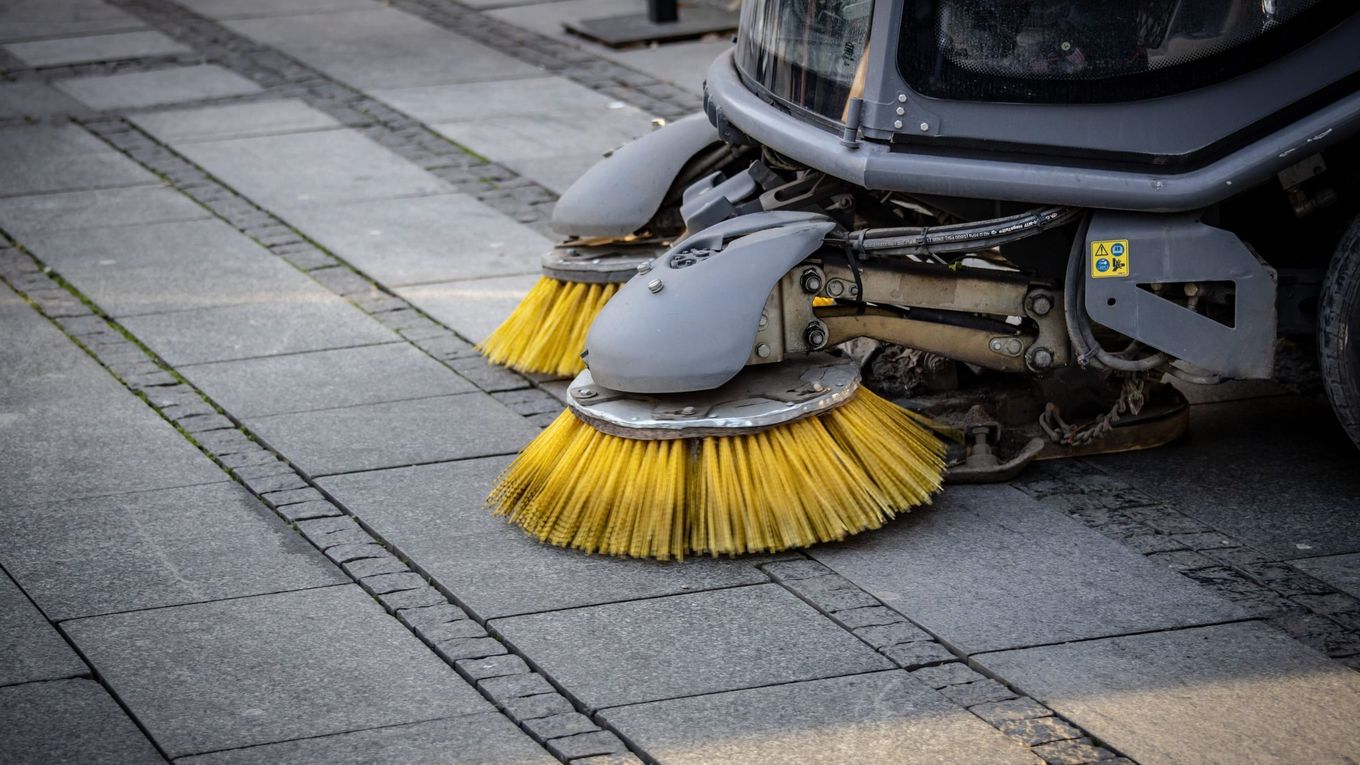
Roller or cylinder brushes clean, de-rust and nap surfaces on production lines. You specify the core, outside diameter and face length, the width that touches the work (Felton).
Conductive brushes, strips and rings are made from conductive fibre and fitted to machines for static bleed and electrical contact.
Anti-static brushes, called ESD brushes (electrostatic discharge), lift dust from circuit boards and drain charge. The manufacturer holds surface resistance in a controlled range.
Polishing and abrasive brushes are discs and wheels for deburring metal, edging glass and clearing solder from boards.
Tube and bore brushes fix filament in twisted wire or a metal tube to clean and deburr holes and threads, down to 0.8 mm bores.
Specification table for your RFQ
Paste this into your request for quotation (RFQ) with your drawing.
| Parameter | Plain meaning | Options and facts |
|---|---|---|
| Filament polymer | The plastic of each filament | Polyamides nylon 6 (PA6), 6.6 (PA66) and 6.12 (PA612) absorb 9.5, 8.5 and 3.0 percent water when saturated; PA66 loses 65 percent of its stiffness from 50 to 100 percent humidity. The polyesters PBT (polybutylene terephthalate) and PET (polyethylene terephthalate) recover less from bending than nylon (DuPont). Polypropylene (PP) suits contact with petroleum products (Precision Brush) |
| Abrasive filament | Nylon loaded with grit | Silicon carbide, aluminium oxide or ceramic grit, 20 to 40 percent by weight, from 36 to 600 grit, in filaments of 0.30 to 1.78 mm (DuPont) |
| Wire | Metal filament | Carbon steel for rust removal and deburring; type 302 stainless for wet work, which leaves no rust on stainless or aluminium; brass, the softest metal fill (Gordon Brush) |
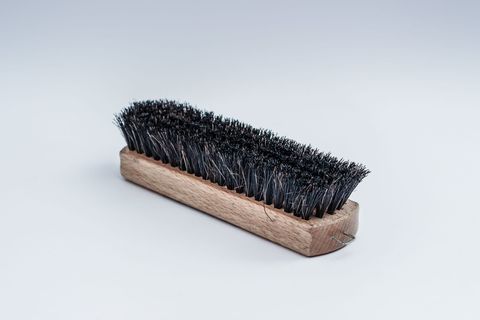
| Natural fibre | Animal or plant fibre | Horsehair for scratch-free dry cleaning; tampico, wet or dry (Gordon Brush) |
| Filament diameter | Thickness of one filament | State in mm. Most brush filaments run from 0.003 to 0.05 inch, about 0.08 to 1.3 mm (Precision Brush) |
| Trim length | Free filament beyond the core or holder | Short trim cuts stiff and fast; long trim follows uneven surfaces (Felton) |
| Fill density | Filament tips per unit area | Higher density lasts longer; lower density flexes over profiles (Felton) |
| Core or holder | What the filament is fixed to | Shaft material, bore, keyway, end fittings; strip profile |
| Dimensions and tolerances | Sizes the brush must hold | Outside diameter, face length, overall length, runout, each with a tolerance |
| Resistance (ESD) | How easily charge flows | The ESD Association, which cites the ESD control standards IEC 61340-5-1 (International Electrotechnical Commission) and ANSI/ESD S20.20, describes a conductor as below 10 kΩ (kilo-ohm), an insulator as above 100 GΩ (giga-ohm), and dissipative materials as in between (ESD Association) |
| Speed rating | Highest safe speed for rotating brushes | Maximum safe free speed (MSFS), the highest speed spinning free with no work applied, in rpm (revolutions per minute); ANSI B165.1, from the American National Standards Institute, is a US safety standard for power brushes (Precision Brush) |
| Operating temperature | Heat at the brush face | PA66 has the highest heat distortion temperature of the three nylons, 300 °F or about 149 °C (Gordon Brush) |
A contract for rotating brushes can name the European standard EN 1083-2:2024, which covers power-driven cup, wheel, end, disc, tube and head brushes and excludes cylinder and strip brushes (EVS).
What you can change and what sets the price
Everything on the drawing is open. Three things set the price. Tooling: a new core, channel profile or twisting fixture is a one-time cost. Filament: PP and PA6 are low-cost filaments, while PA66 and polyester are medium-priced (Gordon Brush), and because brushes are filled by volume, the filament’s density changes how much material goes in (DuPont). Quantity: setup is spread over the batch.
Customs code and duty
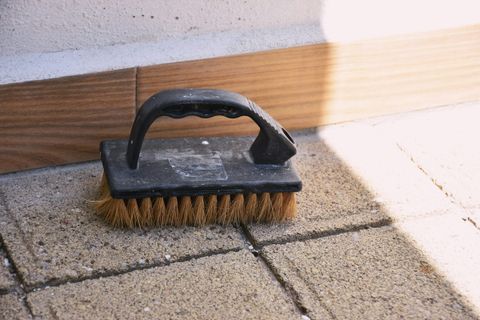
Brushes sit under heading 9603 of the HS (Harmonized System) code, which the EU extends to the eight-digit CN (Combined Nomenclature) code. A brush built to be fitted to a machine goes to CN 9603 50 00, “other brushes constituting parts of machines, appliances or vehicles”, at 2.70 percent third-country duty in TARIC, the EU’s online integrated tariff database, on 12 November 2026 (TARIC). Hand-held technical brushes fall to 9603 90 99 at 3.70 percent (TARIC). A customs broker should confirm each code.
EU rules
CE marking is required only where harmonised EU rules call for it (Your Europe); a brush with no electrical parts carries none. The General Product Safety Regulation (EU) 2023/988 covers products intended for consumers or likely to be used by them (Article 3), so a hand brush sold through retail can fall inside it.
What we check at the factory
We check the business licence, export history and the machine that will make your part, measure samples against the drawing, visit during production and run a pre-shipment inspection before the goods leave.
Questions buyers ask
Can you work from a worn sample with no drawing? Yes. The manufacturer works from a drawing, a spec sheet or a sample, and you approve new samples against the original.
How long does a first order take? With an existing specification: samples in two to three weeks, production typically four to six weeks, then sea freight.
Can you supply a branded replacement part? No. We source white-label and ODM (original design manufacturer: the factory’s design under your brand) goods only; see the OEM (original equipment manufacturing) and ODM guide.
Is the fee charged on top of the factory price? Yes, invoiced separately; the agent fees guide compares it with others.
Sources
- DuPont: Tynex A abrasive filament technical guide (2015)
- Gordon Brush: Bristle brush material descriptions (reprint)
- Precision Brush: Brush filament options
- Precision Brush: Understanding filament thickness
- Felton Brushes: Brush trim, face and fill
- EOS/ESD Association: Understanding ESD control
- EVS: EN 1083-2:2024 Power-driven brushes, Part 2: Safety requirements
- Precision Brush: Brush safety
- EU TARIC: measures for 9603 50 00, reference date 12 November 2026
- EU TARIC: measures for 9603 90 99, reference date 12 November 2026
- Your Europe: CE marking
- Regulation (EU) 2023/988 on general product safety (EUR-Lex)