For springs, metal stampings and die-cast parts, Aslan Sourcing offers a factory search project: we screen the Chinese factories that make your part, visit the shortlist, negotiate in Chinese, pull samples and hand you a ready-to-order file, quoted per project. We have no standing partner factory for any of these processes and no engineers, so you supply the drawing, the drawing is the specification, and we do not review tolerances or design.
Visits, audits and inspections for a supplier you already use are charged at a day rate with travel at cost. If we manage the order, you pay a commission of 4 to 8 percent of order value; see our pricing page. This page gives general information and is no substitute for engineering advice.
Springs
EN 15800 gives quality specifications for cold-coiled cylindrical compression springs made of round wire, including quality grades for wire diameter, coil diameter, spring force and free length (BSI). Its German edition replaced DIN 2095 (AFNOR). If your drawing still cites DIN 2095, update it.
| Line | What to state | Reference points |
|---|---|---|
| Wire material | Grade and standard | Music wire to ASTM A228 (Lee Spring). EN 10270-1 spring steel to 100 °C; stainless 1.4310 to 250 °C (Knörzer). Stainless spring wire now falls under EN ISO 6931-1, which replaced EN 10270-3 in Germany in 2020 (DIN Media); its grades include X10CrNi18-8 and X5CrNiMo17-12-2 (iTeh) |
| Wire diameter | mm with tolerance | |
| Coil dimensions | Outside or inside diameter, free length, active and total coils | Hole larger than the outside diameter, rod smaller than the inside diameter (Lee Spring) |
| Load at length | One or two loads at stated lengths, with tolerance | Load lengths must sit above solid height (Lee Spring paper) |
| Ends | Open, open and ground, closed, or closed and ground | With closed ends, total coils equal active coils plus two (Lee Spring paper) |
| Rate and set | Rate in N/mm with tolerance; whether springs are pre-set | Lee Spring puts the tolerance on the rate and leaves coil count open (Lee Spring paper) |
| Finish | Plating or passivation | Example: zinc plate and bake per ASTM B633 (Lee Spring) |
Metal stampings
ISO 2768-1:1989 set general tolerances in four classes for machined and sheet-metal dimensions without individual tolerances. ISO has withdrawn it; ISO 2768:2026, published in November 2026, replaces it (ISO, ISO). A drawing note citing an ISO 2768 class should name the edition.
| Line | What to state | Reference points |
|---|---|---|
| Material and temper | Grade, temper, standard | Temper (hardness) affects edge breakage and burr (Boker’s) |
| Thickness | Nominal with tolerance | Holes at least as wide as the thickness; stainless may need twice the thickness |
| Tolerances | Critical dimensions toleranced; general tolerance class and edition | Hole tolerances apply on the punched side only |
| Burr | Allowed side and maximum height | Burr depends on die clearance, temper and grain |
| Tooling | Progressive or single-stage | Progressive dies cost more and produce a part every stroke; single-stage tools cost less upfront and suit low volumes (Xometry) |
| Finish | Plating, coating, thickness |
Die-cast parts
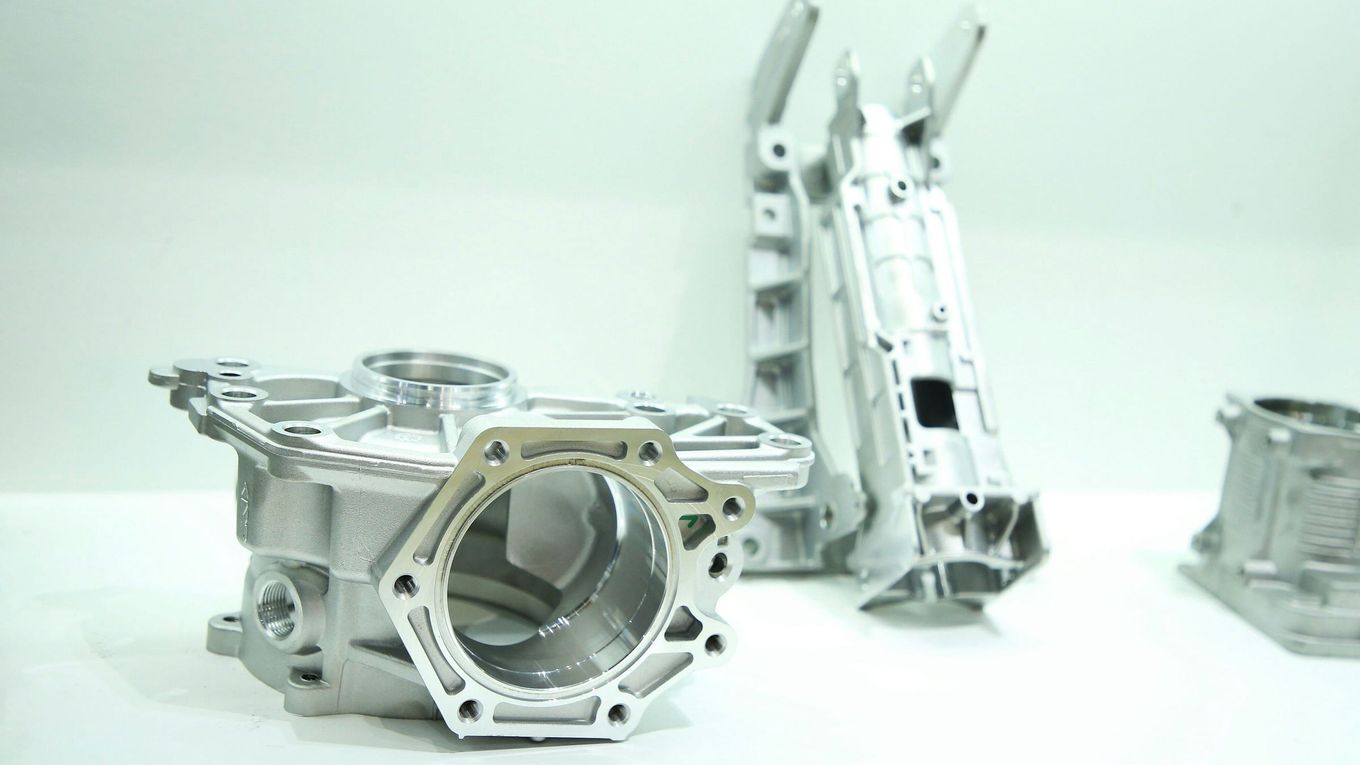
ADC12 is defined in JIS H 5302, the Japanese standard, at 1.5 to 3.5 percent copper and 9.6 to 12.0 percent silicon (Yamaha Motor). Dynacast notes that 383, “also known as ADC12 in Asia”, is often used as an alternative to A380 (Dynacast). In Europe, EN 1706 sets composition limits for aluminium casting alloys (EVS). Name one standard and certify chemistry against it.
| Line | What to state | Reference points from NADCA, the North American Die Casting Association (NADCA) |
|---|---|---|
| Alloy | Designation and standard | |
| Wall thickness | Nominal and minimum | Keep walls uniform; avoid heavy sections and abrupt changes |
| Draft | Angle per surface | Ample draft in cored holes left unmachined, minimum draft where they are machined |
| Porosity | Zones, acceptance level, pressure test if needed | Specify pressure tightness only where essential; agree test methods in advance |
| Machining allowance | Stock per machined face | Remove minimum stock to avoid exposing porosity; impregnation may be needed |
| Surface finish | As-cast class 1 to 5 | Classes do not apply to machined surfaces |
Tooling ownership
Dies, moulds and fixtures are made for your part. Put in writing who owns them, where they are kept, that they make only your parts, and how you collect them. Sign an NNN agreement (non-disclosure, non-use, non-circumvention) before you send drawings; see our NNN guide.
Documents and checks
- First article inspection (FAI): every characteristic on the drawing measured on first production parts. AS9102 sets baseline FAI requirements in aerospace (SAE, revision B, since superseded by a later revision).
- Material certificate to EN 10204 (EVS) type 3.1: issued by the material maker, validated by its authorised inspection representative independent of manufacturing, with test results (Van Leeuwen).
- PPAP (Production Part Approval Process): the standard of AIAG, the Automotive Industry Action Group, “to ensure engineering design record and specification requirements are consistently met” (AIAG). Ask for it only if your customer requires it.
- Tooling photographed and marked with your part number.
- HS code (Harmonized System customs code): left to your customs broker.
See our guides on factory audits and pre-shipment inspection.
Questions buyers ask
Do you have a spring or stamping factory already? No. Our standing relationships are in brushes and vacuum cleaners. Here we run a factory search project for your part.
Will you check our tolerances? No. We have no engineers. The factory quotes to your drawing and we check parts against it.
Can one project cover a spring, a stamping and a casting? Yes. Where the processes sit in different factories, the file holds a shortlist for each.
Who is the importer of record? You are. The factory invoices you.
What about plastic and machined parts? See injection molding and CNC (computer numerical control) machining.
Sources
- BSI Knowledge: BS EN 15800:2008, cylindrical helical springs made of round wire
- AFNOR Boutique: DIN EN 15800 (2009), replaces DIN 2095
- Lee Spring: Compression spring design and general considerations (white paper)
- Lee Spring: Learn about compression springs
- Lee Spring: Compression spring LC095N07M, music wire
- Federntechnik Knörzer: Material table
- DIN Media: DIN EN ISO 6931-1:2020-11, stainless steels for springs, wire
- iTeh Standards: EN ISO 6931-1:2020 preview, grade table
- ISO: ISO 2768-1:1989 (withdrawn)
- ISO: ISO 2768:2026
- Boker's: The designer's guide to precision metal stampings
- Xometry: Progressive die stamping
- NADCA Product Specification Standards for Die Castings 2021, section 6 (copy hosted by A&B Die Casting)
- Yamaha Motor: JIS H 5302 aluminium alloy die castings, composition data
- Dynacast: Aluminium alloy 383 (ADC12)
- EVS: EN 1706:2020+A1:2021, aluminium castings, chemical composition and mechanical properties
- EVS: EN 10204:2004, metallic products, types of inspection documents
- Van Leeuwen: Inspection documents under EN 10204
- SAE: AS9102B aerospace first article inspection requirement (superseded revision)
- AIAG: Production Part Approval Process (PPAP), 4th edition