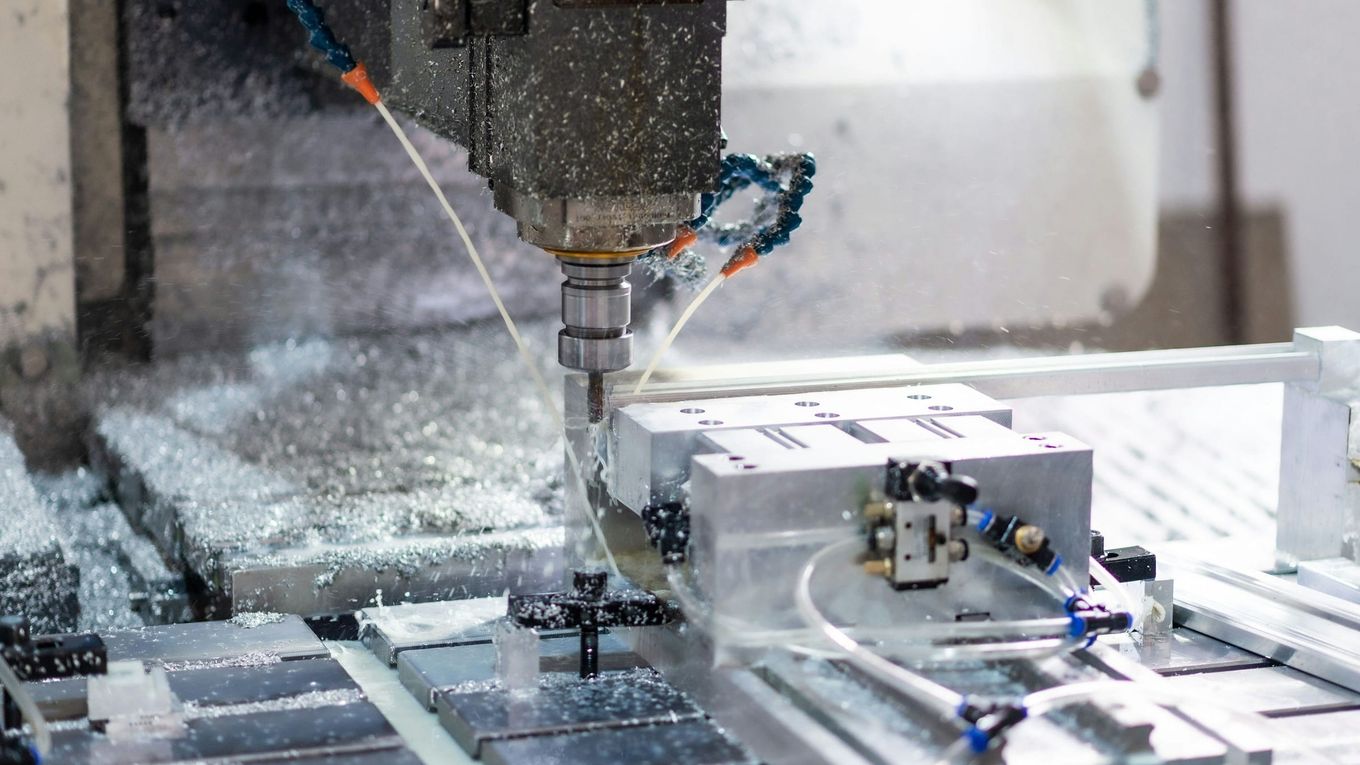
For injection moulding and CNC (computer numerical control) machining, Aslan Sourcing runs a factory search project, quoted per project. We have no standing partner factory for moulded or machined parts, so each project starts with a screen of the Chinese factories that make your kind of part; we then visit the shortlist, negotiate in Chinese, pull samples and hand you a ready-to-order file.
Audits and part inspections at a supplier you already use are charged at a day rate plus travel at cost. Managed orders carry a commission of 4 to 8 percent of order value, paid by you (prices).
When each process fits
CNC machining cuts a part from solid stock. Injection moulding shoots molten plastic into a steel or aluminium mould. The figures below are Protolabs’ for its own service; Chinese factories will quote their own.
| CNC machining | Injection moulding | |
|---|---|---|
| Typical volume | 1 to 200+ parts | 25 to 10,000+ parts |
| Materials | 40+ grades of plastic and metal | 70+ grades of thermoplastic and thermoset resin |
| Precision | Often within a few microns | Wider variation from shrinkage and warpage (see tolerance standards below) |
| Cost pattern | Higher cost per part | Initial costs, lower cost at higher volumes |
| Fits | Prototypes, metal parts, designs still changing | Frozen designs at volume |
Mould classes and steels
The Plastics Industry Association, formerly SPI (Society of the Plastics Industry), publishes mould classifications with estimated lifespans in AR-101, last revised May 2023. The figures below come from the manufacturer Plastikon Industries, in its September 2014 summary of the SPI mould classes for machines of 400 tons or less. That summary predates the 2023 revision, so check the current AR-101 before you specify a class.
| Class | Rated life | Use |
|---|---|---|
| 101 | One million cycles or more | Extremely high production |
| 102 | Less than one million | Medium to high production |
| 103 | Less than 500,000 | Medium production |
| 104 | Less than 100,000 | Low production |
| 105 | 500 or less | Prototypes only |
Fictiv gives typical lives by material: aluminium about 10,000 shots or fewer, P20 steel 50,000 to 100,000, H13 500,000 to one million, and S136 stainless one million or more, with resistance to corrosive plastics such as PVC (polyvinyl chloride) and POM (polyoxymethylene, or acetal).
What drives tooling cost
Cost follows the class you specify, with 101 the most expensive and 105 the least, and the steel grade sets the expected life (Fictiv). Moving parts and manually loaded inserts shorten mould life, and glass-filled resins wear the tool. State the lifetime volume you expect so the factory can quote the right class, and ask for each quote to name the steel for cavity and core.
DFM review
DFM (design for manufacturability) feedback highlights areas of a part that cannot be made and why (Protolabs). Ask for the DFM report in writing before steel is cut, approve each point, and keep it with your drawings.
T1 samples and the approval loop
T0 is the factory’s internal check of the tool. T1 is the first run under production-like conditions and usually the first sample you see (Fictiv). Final textures are often left out of early trials in case the design changes. Parts are measured with calipers and a CMM (coordinate measuring machine) and the results go into a report. Each correction leads to a further trial, T2 and onwards, until you sign off the tool for production.
Tooling ownership: put it in writing
Harris Sliwoski warns that a purchase order line saying the buyer owns the tooling leaves too much open. A tooling agreement should cover:
- The point at which title to the tooling passes to you
- Permanent plates marking each tool as your property, plus a schedule with photos and location
- The factory holds tools as custodian and keeps them segregated and maintained, with responsibility for wear, maintenance, repair, loss and damage set out
- Use limited to your production, with no copies or sales to third parties
- No move to another site without your written approval
- A firm release deadline and delivery place, with no release fees or unapproved storage charges
- A statement that all designs, drawings and tooling-related IP (intellectual property) belong to you, with delivery of moulds or digital files within a fixed number of days (Harris Sliwoski guide)
Inspecting parts
FAI (first article inspection) checks whether a process can consistently make conforming parts, and is repeated after any design or process change (1factory). It is a subset of PPAP (production part approval process). Measurement uses a CMM along with gauges, calipers and micrometers. For material, ask for the mill’s certificate of conformance with its heat lot number. Production batches are then sampled as in our pre-shipment inspection guide.
Tolerance standards: check the edition
If your drawings cite ISO 2768-1, note that ISO (the International Organization for Standardization) lists it as withdrawn. Its successor, ISO 2768:2026, was published in November 2026 and sets tolerance classes for linear sizes from 0.5 mm to 4,000 mm and for angular sizes. ISO 2768-2 has been replaced by ISO 22081:2021. For plastics, ISO 20457:2026 exists because tolerance approaches developed for metal parts cannot generally be applied to moulded plastics. Name the standard and edition on every drawing, and have your own engineer confirm tolerances and your lawyer the tooling agreement; this page only gives general information.
How parts feed an electronics enclosure
In a hardware programme, the first hard tool for each custom part is built at DVT (design validation test), and moulds are locked at PVT (production validation test) (Formlabs). IPC-A-630, from the electronics standards body IPC, sets acceptability for electronic enclosures (IPC). See our AI hardware page, our supplier verification guide, and the Huaqiangbei guide for sourcing in Shenzhen.
Questions buyers ask
Does Aslan already work with a moulding or machining factory? No. We run a factory search project for your parts and build the shortlist from scratch.
Should I machine or mould my enclosure? Machine while the design still changes and volumes are low; mould once the design is frozen and volume justifies the tool.
Which mould class should I order? Match the class to the lifetime volume you expect. In Plastikon Industries’ 2014 summary of the SPI classes, a Class 105 prototype tool is rated for 500 cycles or fewer.
Who owns the mould after I pay? Whoever the contract says. Without a written tooling agreement, recovering it can be hard.
What does Aslan charge for this? The factory search is quoted before we start and part inspections are charged by the day. All our fees are on the pricing page.
Sources
- Protolabs: How to select the best manufacturing process for your part
- Plastics Industry Association: Customs and Practices of the Moldmaking Industry (AR-101)
- Plastikon Industries: SPI class summary (September 2014)
- Fictiv: What to know about injection molding tooling life
- Fictiv: FictivMade part 6, mold trials
- Formlabs: Validation testing in product development, from POC to EVT, DVT, PVT and mass production
- Harris Sliwoski: Who owns your molds? How overseas factories hold tooling hostage
- Harris Sliwoski: The guide to molds and tooling in international manufacturing
- 1factory: A guide to first article inspection
- ISO: ISO 2768-1:1989 (withdrawn)
- ISO: ISO 2768:2026, tolerance limits for general specification of linear and angular sizes
- ISO: ISO 2768-2:1989 (withdrawn, replaced by ISO 22081:2021)
- ISO: ISO 20457:2026, plastics moulded parts, tolerances and acceptance conditions
- IPC: Standards guidance for printed board assemblies, 2026 revision