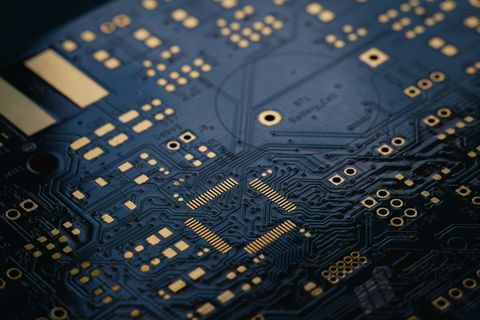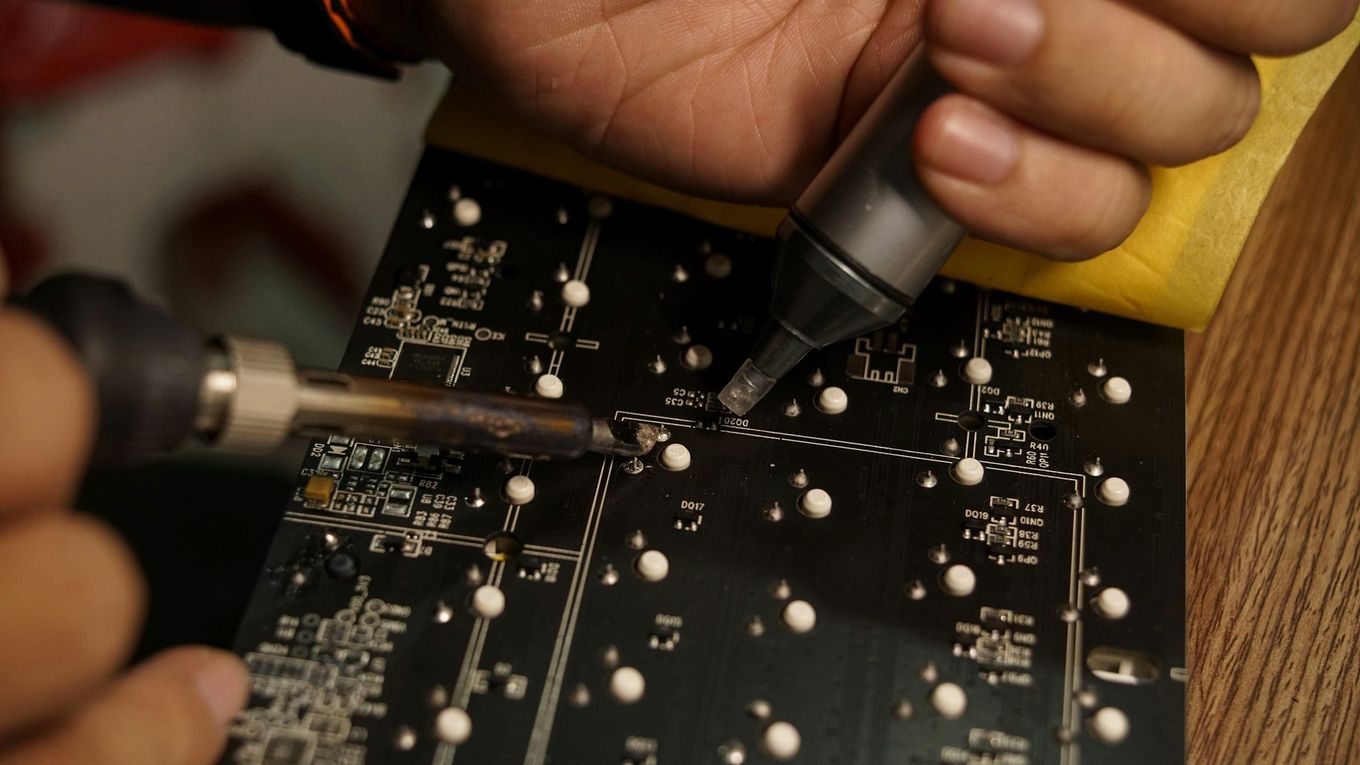
Aslan Sourcing has no standing partner factory in electronics; our standing factory relationships are in brushes and vacuum cleaners. For PCB (printed circuit board) assembly we run a factory search project, quoted per project: we screen the board assemblers across China that build your type of board, visit the shortlist, negotiate in Chinese, pull samples and hand you a ready-to-order file.
If you already have a board supplier, we audit or inspect it on a day rate, with travel at cost. If we go on to manage the order, our commission is 4 to 8 percent of order value, invoiced to you (prices).
Fabrication, assembly and box build
Three jobs are often quoted together:
- PCB fabrication makes the bare board: laminate, copper, solder mask and surface finish.
- PCBA (printed circuit board assembly) solders components onto it.
- Box build puts the assembly into its enclosure with cables and final test. IPC, the standards body now known as the Global Electronics Association, covers enclosures in IPC-A-630 and cable assemblies in IPC/WHMA-A-620 (IPC).
Ask which steps the factory does under its own roof and which it subcontracts.
A specification table you can copy
| Parameter | What it means | What to write |
|---|---|---|
| Layer count | Number of copper layers. JLCPCB lists 1 to 32. | “4 layers, stack-up attached” |
| Base material and Tg | Tg (glass transition temperature) is where the resin turns from rigid to soft. Eurocircuits lists FR-4, the common glass-reinforced epoxy laminate, in grades at 130, 150 and 170 °C and suggests Tg 20 to 30 °C above your highest operating temperature. | “FR-4 per IPC-4101, Tg 150 °C minimum” |
| Copper weight | Ounces per square foot; 1 oz is about 34 µm nominal (Siemens). | “Outer 1 oz, inner 0.5 oz” |
| Surface finish | Lead-free HASL (hot air solder levelling) gives the best solderability but a less flat surface; ENIG (electroless nickel immersion gold) is flat but carries a higher risk of defects such as black pad (Eurocircuits). | “ENIG per IPC-4552” for fine-pitch parts |
| Minimum trace and space | Narrowest copper line and gap. As an example, JLCPCB lists 0.10/0.10 mm for 1 oz two-layer boards. | Your design’s minimum |
| IPC class | Acceptability class, see below | “IPC-A-610 Class 2” |
| Component sourcing | Turnkey: the factory buys parts. Consigned: you supply them (PCBCart). | “Turnkey, approved vendor list attached” |
| Test coverage | AOI (automated optical inspection); X-ray for hidden joints such as BGA (ball grid array); ICT (in-circuit test, a “bed of nails”); flying probe as the cheaper alternative to ICT; FCT (functional test) (Electronic Design). | “100% AOI, X-ray on BGA, FCT per test spec” |
IPC’s producibility levels A, B and C reflect “progressive increases in fabrication cost” (IPC), so tighter features than your design needs cost money.
IPC-A-610 acceptability classes
IPC-A-610 is a post-assembly acceptance standard; revision J was released in April 2024 (IPC) and supersedes the 2020 revision H (IPC-A-610J contents). IPC’s own guidance defines three classes:
- Class 1, general electronic products: the main requirement is that the assembly works.
- Class 2, dedicated service: continued performance and extended life are required; uninterrupted service is desired but not critical.
- Class 3, high performance or harsh environment: downtime cannot be tolerated, as in life support.
Choose the class from how the product is used, and write the class and revision on the purchase order.
Counterfeit components and how sourcing is controlled
SAE International’s AS5553 standard, now at revision AS5553E (2025), sets practices to “procure parts from reliable sources”, assure authenticity, and control and report counterfeit parts. Turnkey assembly makes the factory accountable for parts; consigned assembly puts kitting and tracking on you, and one missing part can stop the line (PCBCart).
- Approved vendor list for critical parts: processor, memory, radio, power
- Purchase records from the chip maker or its authorised distributors
- Lot and date codes recorded per batch; IPC-1782 is IPC’s traceability standard
- Incoming inspection records for each reel
- Your written approval before any substitution
RoHS and REACH in outline
The RoHS (Restriction of Hazardous Substances) Directive restricts ten substances, among them lead, cadmium, mercury and four phthalates, in all products with an electrical and electronic component unless specifically excluded. REACH, the EU regulation on registration, evaluation, authorisation and restriction of chemicals, applies to importers of products from outside the EU, and substances of very high concern sit on the Candidate List. Ask the factory for a RoHS test report per material and a REACH declaration.
Customs: bare boards and assembled boards
Bare printed circuits fall under heading 8534. On reference date 13 November 2026, the EU tariff database TARIC shows a third-country duty of 0% for subheadings 8534 00 11, 8534 00 19 and 8534 00 90 from China. From 1 November 2026 TARIC also lists a customs duty of EUR 3 per item for low-value consignments, those worth up to EUR 150, and a Union handling fee for goods sold by distance sale; ask your courier or broker whether either applies to samples. Assembled boards are classified by what they do, so classify each with a customs broker. The broker’s ruling, and your engineer’s review of the specification, take precedence over this general overview.
For partner types and factory vetting see our AI hardware page and supplier verification guide; for buying parts in Shenzhen, the Huaqiangbei guide.
Questions buyers ask
Does Aslan have a PCB factory it already works with? No. We run a factory search project and build the shortlist for your board.
Which IPC class should I ask for? Class 2 covers products that need long life where interruption is not critical. Choose Class 3 only if downtime cannot be tolerated, as it raises inspection effort.
Turnkey or consigned? Turnkey keeps one accountable party. Consign only the parts you must control, such as a programmed chip you already hold.
Is AOI enough? Optical inspection checks visible joints. Add X-ray, which images hidden solder joints, for BGA parts, and a functional test of every board.
How is a finished batch checked? By sampling against your specification before shipment, explained in our pre-shipment inspection guide.
Sources
- IPC: Standards guidance for printed board assemblies, 2026 revision
- IPC: IPC-A-610J table of contents (March 2024)
- IPC: IPC releases J revisions to two leading standards for electronics assembly (8 April 2024)
- Eurocircuits: What does the Tg value mean
- Eurocircuits: Selecting the right surface finish for your PCB
- Siemens: Copper thickness
- JLCPCB: PCB manufacturing capabilities
- PCBCart: Turnkey vs consigned EMS
- Electronic Design: PCB testing throughout the production process
- SAE International: AS5553, Counterfeit electronic parts; avoidance, detection, mitigation, and disposition
- European Commission: RoHS Directive
- Your Europe: Registering chemicals in the EU (REACH regulation)
- European Commission: REACH authorisation and substances of very high concern
- European Commission TARIC: measures for 8534 00 90, origin China, reference date 13 November 2026